

About Århus Statsgymnasium
Aarhus Statsgymnasium is one of the 8 sixth form colleges or upper secondary schools to be found in the county of Aarhus. The school was built in 1958 and designed by the architects Arne Gravers and Johan Richter. Head teacher is Dorthe Fristrup.
Visit the school building which is also famous for its works by the Danish artist Asger Jorn by clicking here.
There are currently about 750 students in the school between the ages of 15 and 20. They graduate after three years. All in all there are 31 classes. The in-take is 10 classes a year. About 80 teachers make up the teaching staff and the school management includes the Head, the Deputy Head and three Assistant Heads. A financial manager, seven secretaries and five caretakers (including one part-time employee and a student) manage administrative and technical jobs.
Compulsory subjects are Danish, English, history, classical studies, science, maths, social science, religion, PE, an artistic subject, a second foreign language and a choice of two of the following: biology, chemistry and natural geography. You can find more details on the homepage of The Danish Ministry of Education.
Besides the compulsory subjects we offer specialised study programmes and electives - natural sciences, social science and a wide range of languages: English, German, French, and Spanish.
Extracurricular student master classes in Creative Writing, Science, and Media Studies are offered.
School Day
The school day starts at 8 in the morning and lasts until either 1.15 or 3 in the afternoon, i. e. either three or four lessons a day. Each period lasts 90 minutes, and most days offer a mix of academic and creative subjects. The teaching methods are varied: class work, group work, pair work or individual or group-based project work. Two-way communication with the local community is secured through visits to businesses, companies, theatres, concerts, and exhibitions, and politicians, artists, writers, and music groups visit the school as well.
In 2000 the school started on an ambitious plan to integrate project work and interdisciplinary teaching into the timetable with special emphasis on the individual student and his/her growth in the three years. Every class has at least three project periods per year, and the flexible timetable easily incorporates projects and class work into the overall plan.
School Life
The school has a good cafeteria, where the students meet during breaks for a chat and a cup of coffee or some lunch at very reasonable prices.
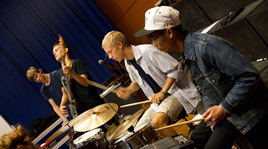
The students have access to both library and computer rooms in their free time and in free periods during the school day. There are various extracurricular activities on offer in the afternoons and evenings: music, art, sports or films.
On several afternoons students can seek help with their homework in so-called homework cafés run and supervised by teachers. The students also organise cafés on some Friday afternoons to meet with friends. Parties are organised on a regular basis, and the school calendar lists all parties and Friday afternoon cafés.
You are always welcome to contact us for further information.
Lorem Ipsum is simply dummy text of the printing and typesetting industry. Lorem Ipsum has been the industry's standard dummy text ever since the 1500s, when an unknown printer took a galley of type and scrambled it to make a type specimen book. It has survived not only five centuries, but also the leap into electronic typesetting, remaining essentially unchanged. It was popularised in the 1960s with the release of Letraset sheets containing Lorem Ipsum passages, and more recently with desktop publishing software like Aldus PageMaker including versions of Lorem Ipsum.
Contrary to popular belief, Lorem Ipsum is not simply random text. It has roots in a piece of classical Latin literature from 45 BC, making it over 2000 years old. Richard McClintock, a Latin professor at Hampden-Sydney College in Virginia, looked up one of the more obscure Latin words, consectetur, from a Lorem Ipsum passage, and going through the cites of the word in classical literature, discovered the undoubtable source. Lorem Ipsum comes from sections 1.10.32 and 1.10.33 of "de Finibus Bonorum et Malorum" (The Extremes of Good and Evil) by Cicero, written in 45 BC. This book is a treatise on the theory of ethics, very popular during the Renaissance. The first line of Lorem Ipsum, "Lorem ipsum dolor sit amet..", comes from a line in section 1.10.32.
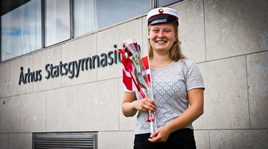

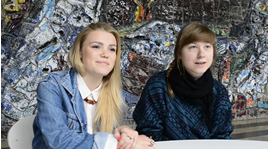
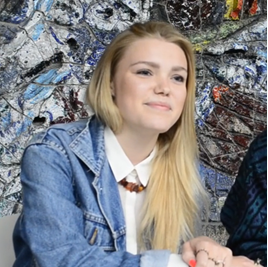
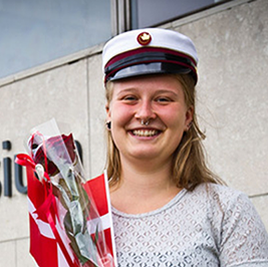
The school building is also famous for its works by the Danish artist Asger Jorn